All week I had been picturing myself making an apple pie with my grandma over Thanksgiving break. I pictured us in the kitchen, peeling apples at the table catching up and spending time together. It felt like the perfect opportunity not just for this assignment, but to learn a recipe I have wanted to and really like. But when I arrived at my family’s thanksgiving there it was already sitting on the counter: a store-bought apple pie, in a cardboard box with the sticker still on it. I had never actually told my grandma that baking an apple pie together was the plan. So, without meaning to, I had replaced our moment with a grocery store pie.
We shrugged, laughed a little, and moved on. “Well,” she said, “we can still make something.” We ended up making yams, they were coated in butter and maple syrup before placing them into the oven. It wasn’t the original baking session I imagined, but it held a different sort of meaning and significance.
As we were preparing, my grandma said, “Just keep them about the same size. They don’t need to be perfect.” That line stuck with me. It reminded me of Kristin Kimball’s writing in The Dirty Life, where she describes how food preparation often contains “a larger loving-kindness.” The yams weren’t special or complicated, but the act of making them together, after an unspoken plan fell apart, felt like that same kind of kindness,
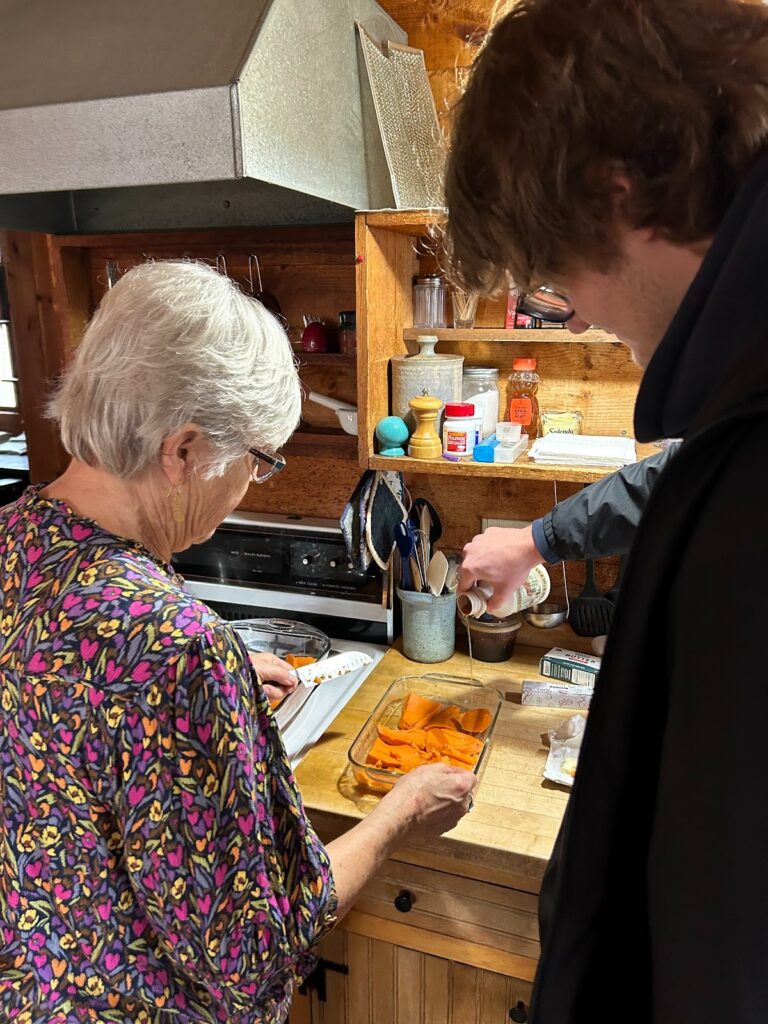
I realized that this dish wasn’t one loaded with family history. We didn’t have a recipe, but I think the maple syrup separated the dish from others making it very unique. It was honestly just what we had time for. And still, the simplicity of it made me think of Kimmerer’s idea in Braiding Sweetgrass: that gratitude doesn’t depend on perfection, it depends on attention.
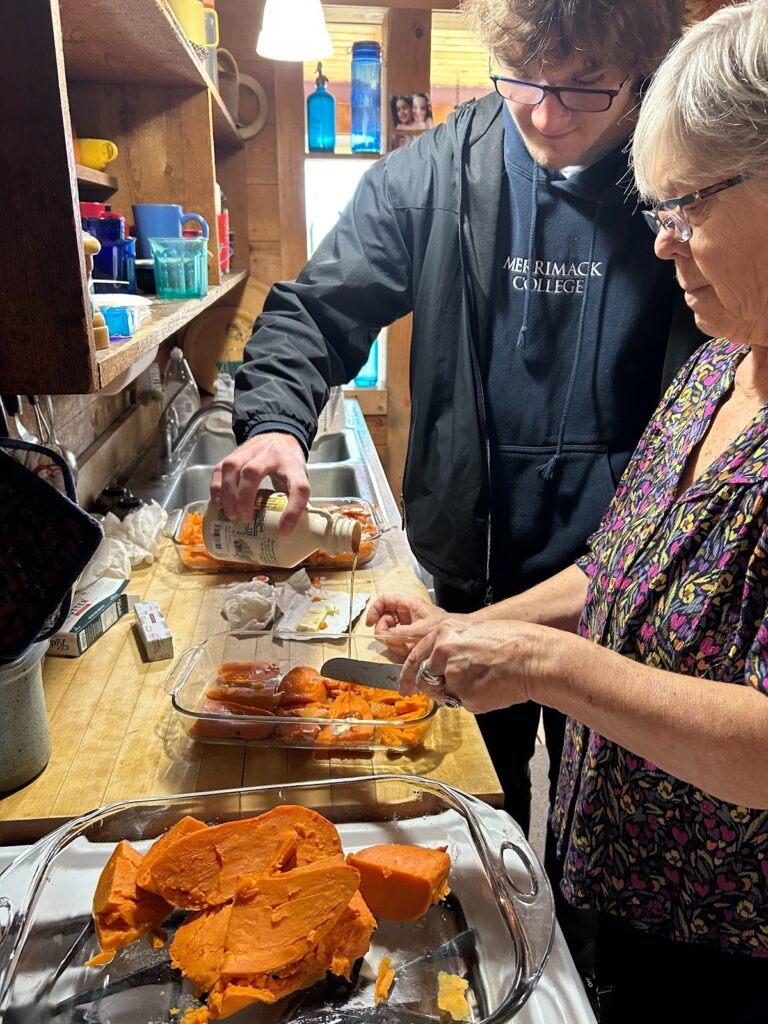
The mishap also taught me something about myself: I rely too much on the picture in my head. I wanted everything to just happen and I forgot it required communication, not assumptions. But food, life, thanksgiving, relationships all have something in common, not everything can be scripted. You show up, things shift, and you adjust. Sometimes you get the homemade pie, and sometimes you get the one from the store.
When we served them at dinner, people dug in without hesitation. I ended up telling everyone the story of the forgotten plan, and my grandma just shook her head and laughed. The sharing became its own little moment, Like in Farm City, where Novella Carpenter writes about how food often brings out the stories behind the scenes more than the food itself, our yams turned into a conversation starter about miscommunication, holidays, and family.
If I were to improve this reflection I’d take better and more intentional photos. I’d also ask her more about her own cooking memories, letting the storytelling go deeper. Even without the apple pie, the moment taught me to appreciate the imperfect and to find meaning in unexpectedness.