
Observing the differences in lifestyle, values, and eating between Greece, Italy and other Blue Zones in contrast to the United States
“We have the blueprint to reproduce longevity in our lives. And I became obsessed with that notion.” – Dan Buettner, Creator of Live to 100 Secrets of the Blue Zones, Netflix.

Alt Text: A view of a street in Athens, Greece on a cloudless sunny day with the end far in the distance ahead. Tall, crammed houses and small cars fill both sides of the road with one small tree on one side and a greek flag high on the other.

Alt Text: The view from the top of the Acropolis, Athens, looking down on the city. Several homes and buildings lay far below, with burnt red rooves and white walls for miles. Roads and trees are sparse, and a short mountain lies on the horizon.
It was July 18, 2024, and our flight had just landed an hour ago in Eleftherios, Vanizelos, Athens. After dropping everything at our colorful xenodocheio (hotel), we left the orange and green coated lobby, and immediately walked down the busy streets of Athens to a nearby cafe. My first purchase outside of the United States with my fresh sheet of euros was a freddo espresso (greek iced coffee) and a fresh spanakopita (spinach pie). The first sip and bite was as engraving as that unforgettable mountain view. The coffee was rich, smooth, and dark, but not bitter and tasteless. The spanakopita was flaky, green, and so perfect it was nearly indescribable. I had no clue food could taste this good, even though I ate these exact same foods in the States.

Alt Text: A plate with a block of feta cheese, cucumber slices, and diced tomatoes. Behind the plate are two glasses of water, one with lemon, and a European skinny Coca Cola can.

Alt Text: A deconstructed pork gyro. The plate includes sliced tomato and onion, pork, French fries, pita bread, and tzatziki.

Alt Text: A plate of a leg of lamb, lemon wedges, taramosalata (fish roe) and potatoes. Salt and pepper shakers and glasses of water and beer are behind the plate.
I’ve grown up Greek, loud and proud. Whenever I choose to eat out at a restaurant, even now as a young adult, my Yiayia (grandmother), 80 years old with jet black hair as vivid as her fashion choices, still shows a visible frown, knowing her home cooked Greek classic dishes are beyond anything at Chili’s or Texas Roadhouse, and she’s right.
Back in Greece- the excellence of the food wasn’t just at that cafe. At a restaurant in downtown Athens, the tomatoes, cucumber, and watermelon were so different to their American counterparts that they tasted entirely different. They were all sweet, powered with flavor, far from filling, and shocking enough to leave me leaned back in my chair speechless. Yiayia’s cooking is still fantastic, but I felt like I was in a new world. The only thing as apparent as the shocking quality of food in Greece was the lifestyle I adopted on that vacation.
Alt Text: I stare into my front facing camera on Snapchat after breakfast in Athens, documenting that it’s “Day 2 in Greece and I think I just ate 500 calories of what would be like 1400 in the US”.

Alt Text: The long pathway leading down to the side of a cliff in Molyvos, Lesvos, Greece. Houses, small cars, and buildings fill the left side of the pathway, while a guardrail and small electric scooter-bikes lie on the right. A few people are seen walking or sitting on tables on either side to eat or socialize. More houses and a mountain fill the distance.
Aside from trips in taxis and a rental car around our ancestral island later in the trip, my family and I walked everywhere. With an average temperature of 98 degrees, an absence of humidity, a UV of 9 or 10 daily, and the healthiest skin and tan I’ve ever had, I noticed my day to day mirror those of the older locals. Each day was spent both relaxing and with movement, walking up and down hills, along with a mid day rest before staying up until 1 or 2 in the morning. This additionally consisted of eating to my liking without craving for junk food, and losing weight with plenty of time in the sun.
Two weeks later, I was back in the States, refreshed, yet scowling at my first sip of my usual Dunkin’ order, cream and caramel swirl, which I should add is no fault of the worker who made it. I struggled to comprehend how even with my busy lifestyle back home, bartending and moving around for hours on end, then playing basketball with friends at night, how quickly I began to put the weight back on I had just noticeably lost in Europe. The heat of early August in fast paced Massachusetts was a water droplet to the ocean of Greece’s laid back, peaceful, and unfathomable way of life.
One morning on social media earlier this year, I was reminded of Dan Buettner’s 2015 book, “The Blue Zones Solution: Eating and Living Like the World’s Healthiest People” (Buettner), where Author and National Geographic Explorer presents seven blue zones, which he coins as places in the world where people lived a longer and higher quality of life with old age. The official blue zones website lists the original five locations as Okinawa, Japan; Loma Linda, California; Nicoya, Costa Rica; Sardinia, Italy; and Ikaria, Greece. Buettner would go on to lead a Netflix special in 2023, “Live To 100, Secrets of the Blue Zones” where he travels to each of the original 5 blue zones and more, uncovering the lifestyle, food, and values of each region.
Interactive 5 Blue Zones Map by Jimmy Kritzas
https://www.google.com/maps/d/u/0/edit?mid=1UoMxWhV771uA915IizegcPD-i6nBbJE&usp=sharing
Interactive, dark palette map of the earth provided by Google My Maps, with 5 pinned locations in each of the blue zones, with additional information provided when clicked upon: information on zones provided by Netflix special “Live to 100: Secrets of the Blue Zones”.
In the episodes of the Netflix special where Buettner visits Italy and Greece, a few striking similarities occurred reminding me of my time in the latter country. Herbal teas, the use of unpasteurized honey, olive oil as a main source of fat, an emphasis on love, antioxidant wine, and dance/laughter were the pillars of Ikaria. Incline/decline through walking, good carbohydrates, control of stress, and care for elders and family were the core of Sardinia. In Greece, I noticed an abundance of family, love, and celebration through natural food and drink, all which accompanied that wonderful balance of natural exercise and stress relief through rest. Even in other blue zones presented like the episode on Loma Linda, a majority plant based diet seemed eerily similar in structure to the foods I grew up eating.
It’s no surprise that the Mediterranean Diet and areas like Italy and Greece are synonymous with good health, but I wanted to dig a little deeper. With added curiosity about the Mediterranean Diet and its benefits to a longer life, I consulted Registered Dietician Samantha McCarthy of Cedardale Health and Fitness to discuss the Mediterranean Diet and balance between diet, exercise, and lifestyle choices, and what we get wrong here in the United States, especially with meat-led Mediterranean foods like Gyro, Shawarma, and Lasagna mass promoted to the public. When asked about this, starting with the core foods of the Mediterranean diet, Sam responded:

Alt Text: Jimmy and Sam McCarthy smile for a selfie. Jimmy holds the phone, wearing a black quarter-zip sitting across a desk from Sam, who is wearing a dark gray hoodie in her office. The desk is wood and dark brown. Jimmy’s laptop is in front of him, closed, and is a forest green.
“Plant-based foods, so not just fruits and vegetables. We tend to think of those 1st, but just the huge amount of legumes and not seeds, things like lentils… and all different types of beans. And then, of course, the fats, the healthy fats, the olive oils. Those are two of the big cores of the Mediterranean diet…I mean, Americans, we love our meats and we love our dairy products. However, both of those are very high up if we look at like kind of a Mediterranean diet pyramid. It’s kind of like the opposite of what a typical American eats. When we look at those pyramids, we could like literally swap it and flip it over the Mediterranean diet pyramid, and it would be the American diet.”
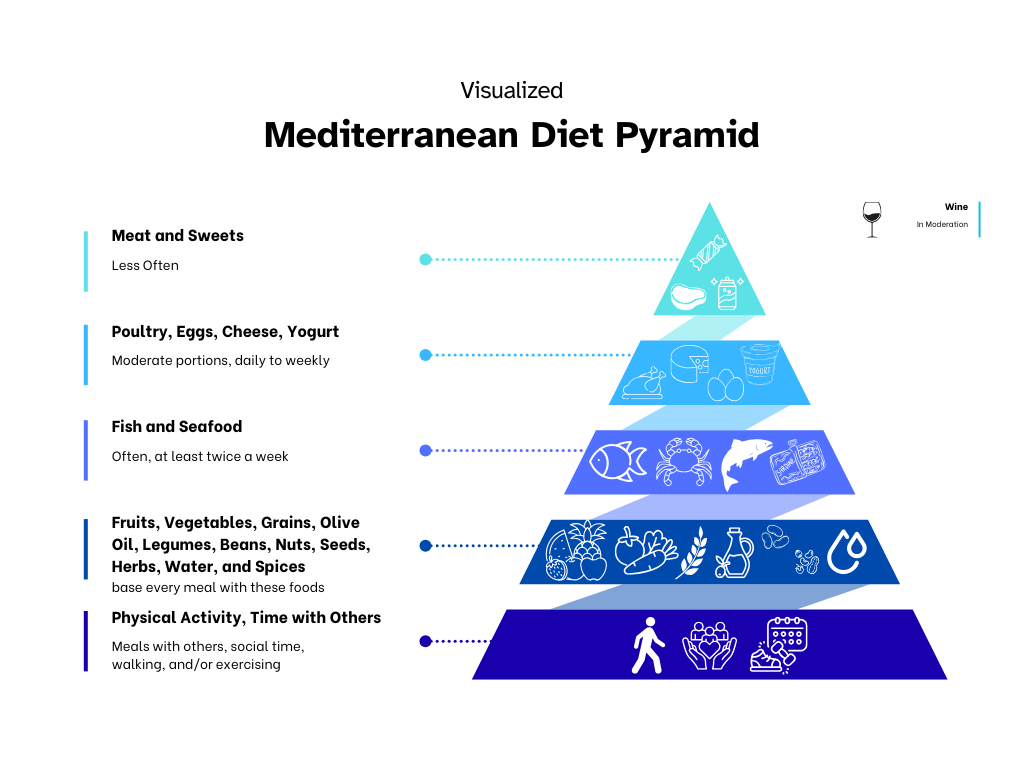
Alt Text: The Mediterranean Diet Pyramid, showed in 5 stages separated by shades of blue. At the bottom for most often is physical activity and time with others; then fruits, vegetables, grains, olive oil, legumes, beans, nuts, seeds, herbs, spices, and water; fish and seafood; poultry eggs cheese and yogurt; and meat and sweets at the lowest, with wine in moderation.
Additionally, I asked Sam for her opinion on what can help a client move past the initial appeal of a diet and the stagnation that follows, along with where that initial appeal comes into play with the Mediterranean diet as well:
“I call that like the honeymoon phase when they 1st start with me or on a plan or something of that sort, where there’s just an enormous amount of motivation and excitement about making change. And then at some point, that starts to drop significantly… It’s really more what gets in the way, what are those barriers, what are those challenges? Why are they getting in the way? And how can we work around those? I find that a lot of people want to try to get rid of those and that’s not often possible. because a big one is stress. You can’t get rid of stress. part of life, right? But how can we work around stress?…We assume diets are restrictive…The Mediterranean diet is not like that. It’s extremely filling because it’s so high in those good healthy fats and in fiber because of all those plant-based foods. So, I think that’s an extremely enticing part of the Mediterranean diet, is that you just don’t feel hungry all the time, which we shouldn’t. Remember, it goes back. Food is our gas. We have to fuel our body, not restrict it and cut back on all that fuel.“
Sam’s response ironically mirrors the lifestyle of the Sardinian’s, with the ability to maneuver through stress in their work, followed by avid social time, and the faith and hope for the future with intent to change. Sam additionally notes that any good practice of diet can lower inflammation and risk of chronic disease. Towards the end of my interview, Sam also answered that she believes diet is more powerful than exercise, but also left a lasting image as to why.
“…the way that I describe it is if you look at a typical 24 hour day, even if you are exercising almost every day, that’s still maybe only an hour a day…So what are you doing the other 23 hours when you’re not at the gym?…your gut health improves with the Mediterranean diet, that also affects your mind too. Um, whether it’s depression, anxiety, other mood disorders, or more severe mental health issues, you know, in also preventing, you know, dementia later on in life.”
In the United States, our culture is powered by the idea that “busy is good”, but with packed schedules also comes eating by convenience and quick fixes. I often think about how unsettled I was in Greece. Not only by the culture shock, but by how much I felt that I had something due that needed to be done, being relaxed for such a prolonged period of time. The beliefs of modern Americans are optimistic in terms of their lifestyle, showing bursts of energy in their want to eat healthy. To our credit as Americans, I believe that the roots to that goal lie in productivity, similar to those who get up daily and move their body in each of these blue zones. However, in order to achieve a healthier diet, I believe that Americans need to see beyond the quick fixes, and ultimately strive towards attention and intent toward a healthier lifestyle altogether, one that mimics, in some capacity, what I saw in Greece, and what Buettner uncovered visiting several blue zones. Factors should be a plant and natural based/Mediterranean diet, ample walking and movement of the body as a regular routine, belief in the possibility of the future, and the love for community and one another. Altogether though, effective results should include all of them.
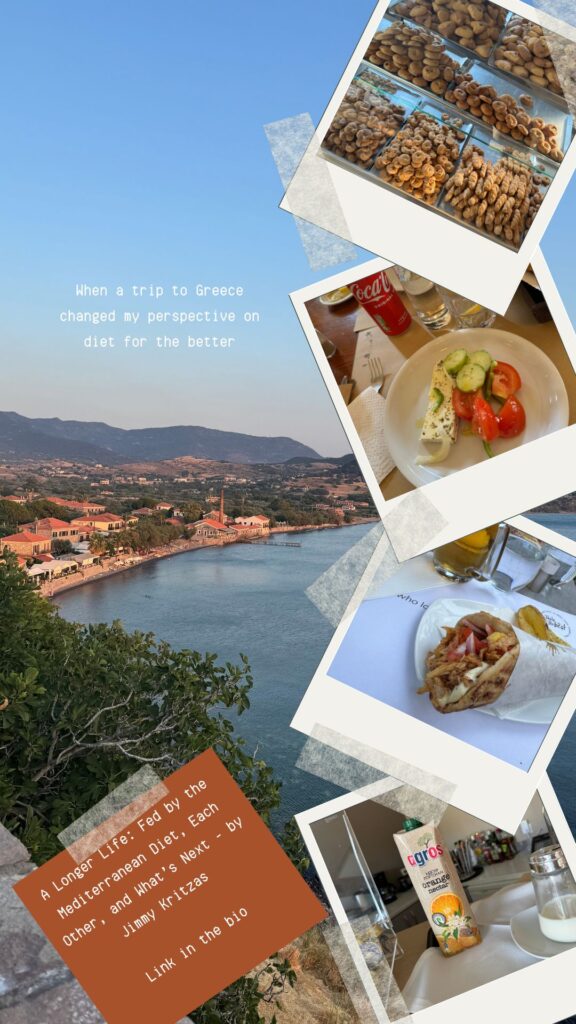
Alt Text: Background photo shows Lesvos, Greece from the side of a cliff, with small houses and buildings with red rooves in the distance. The ocean separates the cliff from the shore and a mountain is seen in the far background. Four print-out photos taken by Jimmy in Greece are taped onto the background, showing greek pastries, the earlier shown feta and vegetables, a chicken gyro wrap, and Greek orange juice. A taped on post-it note lists the title of the story, and text high above states “When a trip to Greece changed my perspective on diet for the better.”
I can’t wait to go back to Greece again, and I think that the food, lifestyle, and human experience is one every American should experience, or even the likes of another blue zone if they are able, especially if they want to prolong a healthy, happy life.